

Why are men allowed to have flaws when women aren't?
Men’s idiosyncrasies are romanticized, while women’s are seen as flaws to be needled, starved, or built anew.

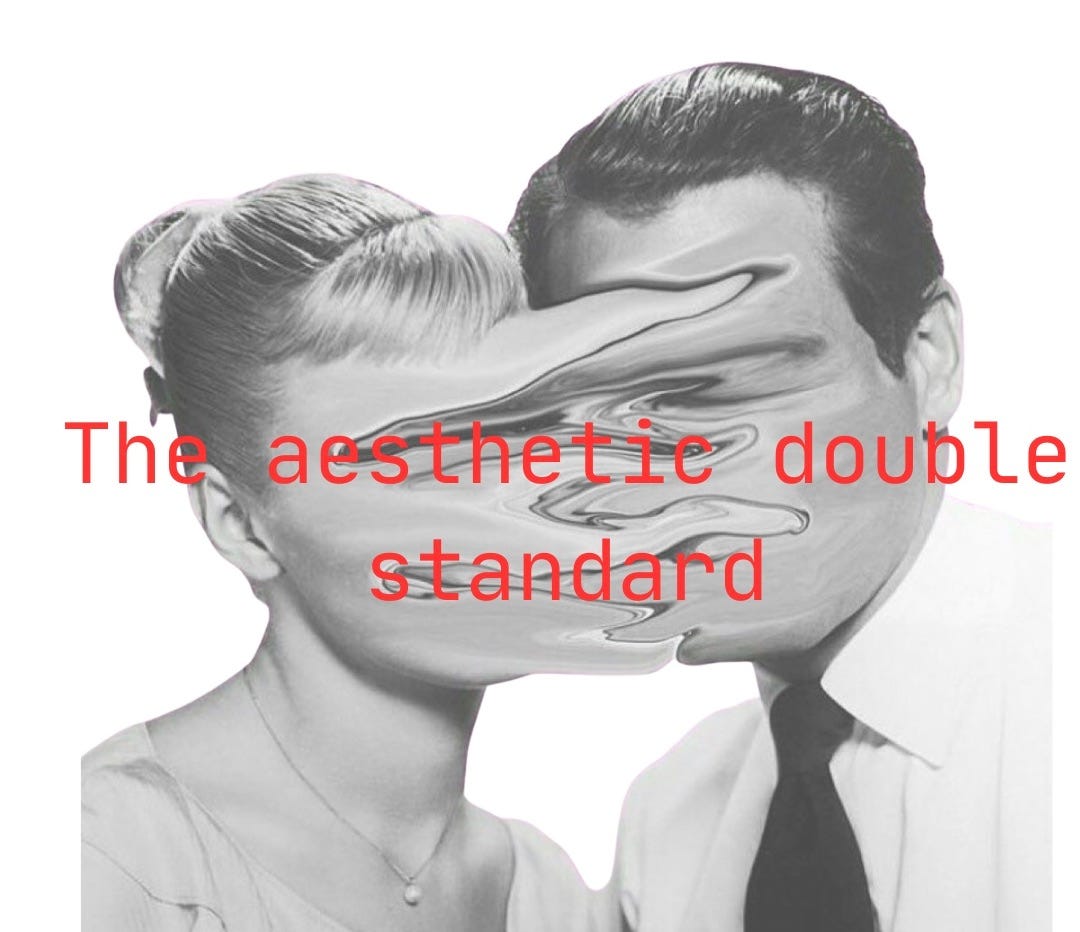
Over a friend’s birthday dinner on Friday, David Harbour’s treatment of Lily Allen inevitably found its way into conversation. We were about 30 seconds in when a friend quipped, “he’s not even good-looking,” and another countered that he and Allen were, in her opinion, aesthetically well-matched. My eyebrows gathered in disagreement: Allen is doe-eyed and raven haired, and looks about 20 years younger than the Hagrid-dupe that is Harbour (I feel bad putting down Harbour’s appearance to drive a point here, but it feels marginally justified by his behavior). But my friend was onto something: when rumours of their romance first circulated, I was warmed at the idea of the fuzzy paternal figure from Stranger Things dating Allen. Their beauty gap, so to speak, didn’t cross my mind, nor did it cross the media’s.
You best believe, however, that if a conventionally attractive 34-year-old man started dating a notably less attractive 44-year-old woman (the ages the pair were when they met), she would be at the receiving end of a deluge of trolling comments about her unfortunate DNA arrangement. The French president Emmanuel Macron’s wife, Brigitte Macron, for instance, is constantly mocked and vilified for her age (for the record, I think she’s stunning).
In other words, the reason Harbour and Allen’s beauty gap didn’t spring to mind wasn’t because there isn’t one, but because she’s the woman and he’s the man. Harbour can be celebrated for his protective teddy-bear look: his attractiveness can come from attributes other than conventional beauty, because society frames men’s idiosyncrasies not as flaws, but as charm in disguise. From the supposition that men look better with age, to the glorification of the ‘dad bod’, to receding hairlines becoming hot at the hands of Walton Goggins, the list of negative traits flipped into positives for men’s benefit is endless.
Women’s flaws, meanwhile, are not framed as hotness. While Allen was in the midst of the marital troubles chronicled in West End Girl, netizens and the media alike called out her weight. In 2010, South Park aired a warped, close-eyed depiction of Sarah Jessica Parker and referred to her as a “transvestite donkey witch.” Then there’s the spate of female celebrities who’ve been driven to eating disorders and medical intervention at the hands the press; the mocking of former child stars when they gain weight post-puberty; the sea of online trends inventing flaws like being a “bottom tooth talker,” and the tendency to equate women’s looks with morality (last week, someone took to X to write, “God made your hair thin as a punishment for your greed,” aimed at Taylor Swift.) When it comes to women of colour, it’s worse: they’re at the receiving end of the same aesthetic sadism, this time with a side of blatant racism.
So, what bore the double standard?
The media is, of course, behind the majority of the mentioned abuses. Magazines and social media accounts critique women’s appearances in part to get clicks (in a society that equates beauty with morality and worth, women can find relief in posts highlighting other women’s flaws). Magazines also enjoyed at least half a century of telling us what men want and don’t want from us (this is done less so now, but we’re still feeling its aftershocks), which, per Naomi Wolf in The Beauty Myth, had more to do with pushing advertisers’ agendas than pushing men’s. Just like women, men have the ability to see women’s idiosyncrasies as beauty, but the media doesn’t, and there’s a knock-on effect.
Societally, there’s also a greater onus on women’s beauty than there is on men’s. Historically, men’s value came from their success and ability to provide, while a woman’s value came from her looks, as that’s what enabled her to find a man who could grant her that security. Needless to say, if your value and place in life rest on your appearance, there’s little room for flaws. (There are, of course, millions and millions of men who see women as human, not a sum of hot parts.)
But while men’s compulsory position as the provider dwindled, the aesthetic pressure on women stuck. This made for the ideal bedrock for the wellness, beauty, fashion, and fitness industries to prey on those flaws and invent new ones. A few weeks ago, I fell into a chin dimple botox rabbit hole: presented with images of puckered chins that resembled my own, I did the mental maths of how I could swing it. I eventually decided against it, and in doing so, withheld around £24,000 from the aesthetics industry across my lifetime. (Botox costs around £120, and you have to get it every three months). In her book Trick Mirror, Jia Tolentino described today's ideal woman as “an ordinary woman reproducing the lessons of the marketplace.” If we refuse to reproduce those lessons and stop demanding that women celebrities do (by accepting our flaws and theirs), we render the $677 billion beauty marketplace obsolete. Needless to say, capitalism doesn’t like that.
There’s also the age-old theory that when it comes to choosing a partner, women aren’t as aesthetically driven as men. Scientists often posit that this is down to evolution; the fact that it’s more critical for us to choose a kind man who won’t abandon us and our children than a guy with a jawline that could cut glass. Wolf, however counters that it’s learned: a result of not being as bombarded by images of conventionally attractive men from childhood, and thus not holding them to such a high standard.
Entitlement also plays a role. Straight, white, cis men are promised the world. Many feel that this promise includes some iteration of the ideal woman (even as this ideal gets narrower and narrower at the hands of the internet), a fact that inceldom has mercilessly proven. Meanwhile Women, as “the second sex”, seem to feel less entitled to partners and celebrity heartthrobs who resemble the perfect man. Many have a soft spot for rat boys and short kings, and go for “medium-ugly” men in the hopes that they will treat them better, a trend known as “shrekking.”
In 4ChanStan, Allen sings “you’re not even cute, though.” Indeed, like Allen, women are capable of criticizing men’s appearance. We do, however, seem better primed to find attractiveness in less conventional traits, or at least to more readily overlook them in search of something deeper. As observed by Wolf, “women are able to view men just as men view women, as objects for sexual and aesthetic evaluation; we too are effortlessly able to choose the male ‘ideal’ from a lineup…Given all that, women make the choice, by and large, to take men as human beings first.”
*When I refer to ”flaws” in this essay, I’m referring to traits generally considered so by conventional (often problematic) beauty standards, not personal opinion.
A few other pieces I’ve written over the past few weeks, including some dating says for Vogue, my take on that Galliano show for ArtReview, and my interview with Scott Eastwood for Flaunt:
https://artreview.com/in-fashion-is-vulgarity-ever-worth-it/
https://www.vogue.co.uk/article/women-dating-younger-men
https://www.vogue.co.uk/article/going-exclusive
https://www.flaunt.com/post/scott-eastwood-get-in-the-ring-issue
From January, these last-Thursday-of-the-month posts will be available to paid subscribers only, so please do up your tier if you can <3.